

“Renaturalization,” is one of 36 (subject to change) stand-alone chapters in Egress, my hybrid “novel.” Not done closing in: 82 percent.
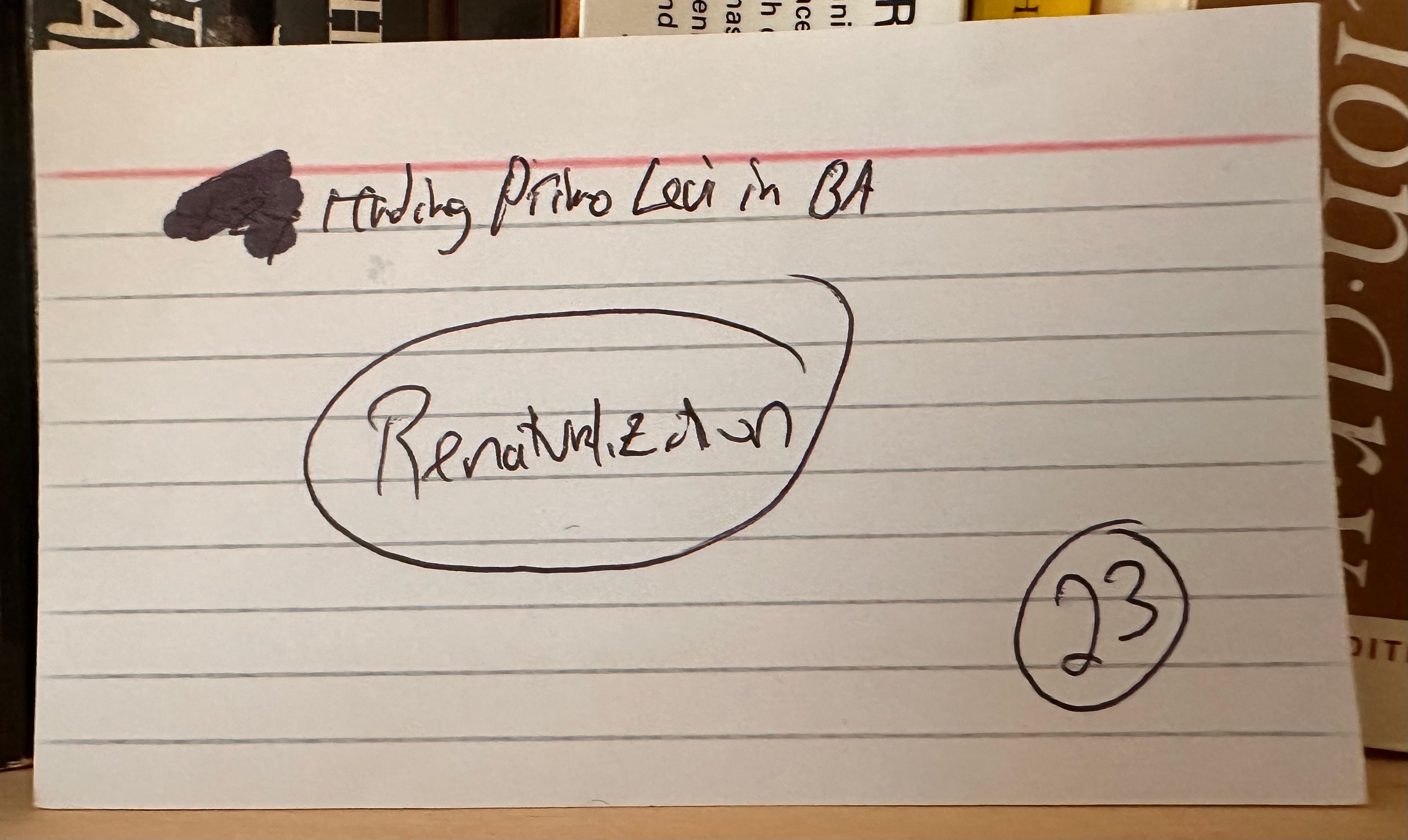
The chapter is about applying for German citizenship via Article 116(2) of the German Basic Law, which restores citizenship to people (and their descendants) who were persecuted and denaturalized by the Nazi regime between 1933 and 1945. Me, three of my seven siblings (but not my father, he wanted no part of it), two of my five cousins, and fifteen out of twenty-three of the next generation, including both my boys. The application was submitted a little over a year ago, still pending, but we’ve been assured that our paperwork is in order, it’s just a matter of waiting out the bureaucracy. Any day now. The chapter is also, more broadly, about being a confused Jew.
Hybrid and “novel” because fiction, memoir, and essay—mixed, blended, who knows what’s what. The card is also a reminder that the reason these index cards exist is as source material for Egress. Some of the notes, like this one, have been assigned to chapters, most have not. Most, in fact, were in danger of never seeing the light of day. The Index Card Project is about rectifying that. A solution, of dubious utility, to a problem that might better have been left unsolved.
As for the note itself, there’s not much to it. D., the younger, was visiting R, the elder, who was living for a year post-college in Buenos Aires. It’s the spring of 2022. There’s a picture of D. sitting in a café reading Primo Levi, a glass of vermouth or Fernet and Coke on the table next to him. I’m happy because D. is reading. He wasn’t a reader for many years, but that changed during the pandemic. And I’m happy because I know that R. took the picture, they’re together. I want and need them both to know: you are your brother’s keeper. Lovely and I aren’t going to live forever.
Lovely and I went to BA too. There’s a scene from that trip in “Renaturalization.” When Lovely, R., and I enter a bakery, the older men kibbitzing in the corner look up at us and immediately avert their eyes. We are Jews. They are—I guess, I assume—not.
Two years later, in the summer of 2024, on a nearly 100-degree day, Lovely and I visited Primo Levi’s home at Corso Re Umberto 75 in Turin. His family still lives there. It’s where he died. On the morning of April 11, 1987, the building concierge rang his bell and handed him his mail. Minutes later, Levi was found at the bottom of the stairwell, three floors down from the landing outside his apartment. No note. No witness. His biographers all concluded suicide. The family accepted the verdict. The Chief Rabbi of Turin refused to condemn him to the section of the cemetery reserved for suicides, declaring the death, in view of his Auschwitz internment, an act of “delayed homicide.” His gravestone bears only his name, his dates, and 174517—his prisoner number, tattooed on his forearm. Elie Wiesel famously said, “Primo Levi died at Auschwitz forty years later.”
Lovely and I stood in the spot where he died. We looked up at the circling stairs. We looked at each other. We did not speak.
Later that day we tried to see the Shroud of Turin but failed. I can’t remember why. Maybe the museum was closed, or we were just hot and hungry. Turns out it’s only a replica anyway. The real one is hidden away elsewhere, viewable only by papal decree.
We had an excellent lunch—a salad of boiled potatoes, carrots, peas, and green beans with mayonnaise; agnolotti with sage and butter; grilled lamb chops (Lovely kept excellent notes)—and for dessert the best gelato (barley!) I’ve ever had. A pleasureful, even joyful, if also sorrowful, afternoon. The place had clearly been around forever, and we wondered, as we sipped the deliciously bitter, herbaceous local digestivo that had appeared on our table, whether Levi had ever eaten there. We decided yes. And were happy thinking so.
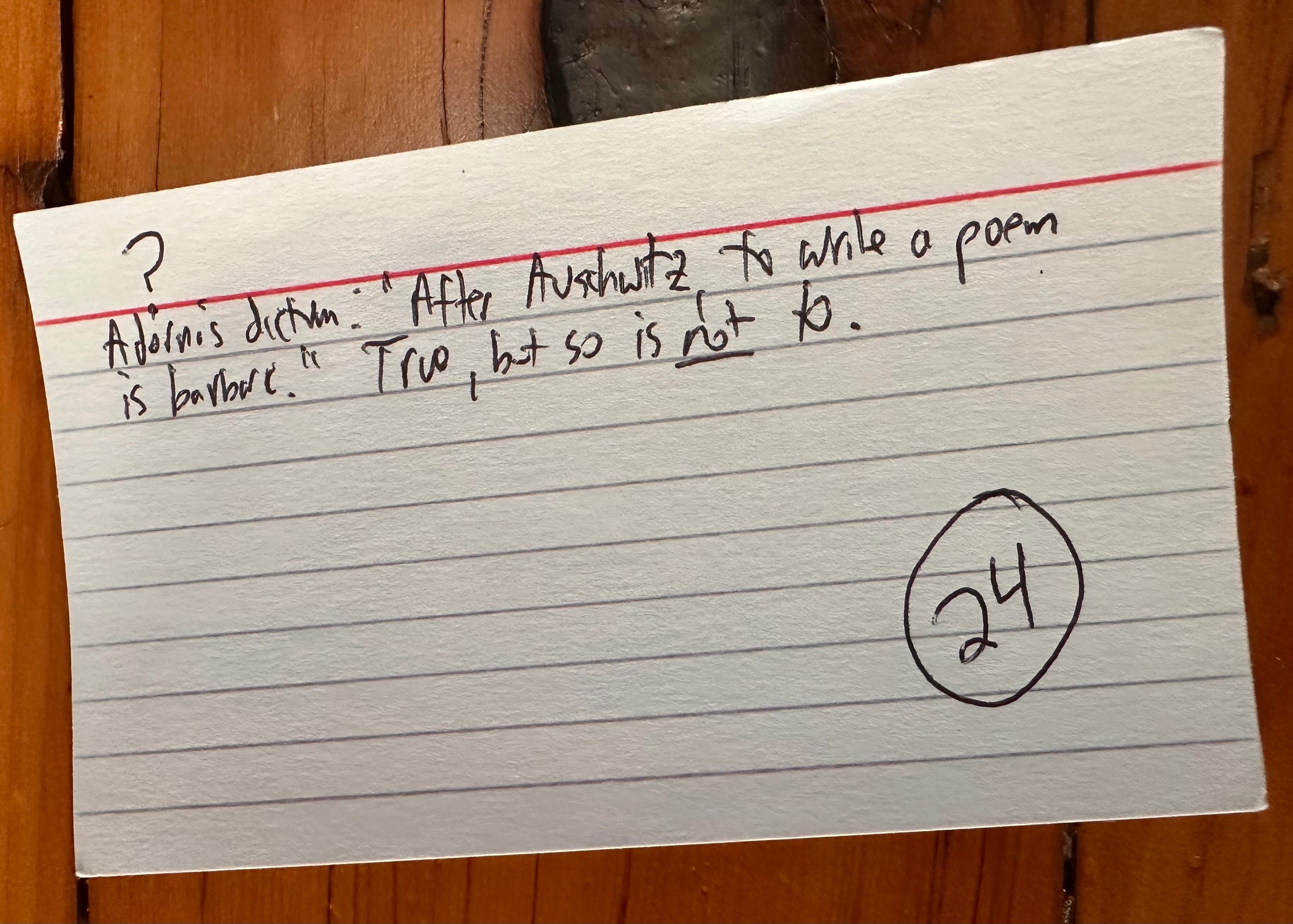
(You might think I cherry-picked this card. I don’t think I did. In my defense, I have a lot of Holocaust-related notes.)
In the fall, I wrote a poem. Actually, I wrote a few. It’s not my usual MO, but maybe it could be.
Reflections from a Damaged Life
Behind the dead oak: three dead squirrels. There’s grass in the bed and congealed lamb fat on the counter. I put deodorant on before my shower. I have inklings. I can’t find the corkscrew. I can’t see the moon.
“Sir! Hello, sir. Are you okay? Do you need help?”
All I want to talk about is the humidity and how to peel an onion. My phone flashes and vibrates, buzzes and beeps. Blood gushes from my gums.
We drink whiskey. We eat anchovies. We read Adorno.
What else can we do?
I cut some lines, including an epigraph, from the beginning of the poem:
“The whole is the false.”—Adorno
Drunk goats, farting dwarves, weighted blankets, speculative praxis.
Fire in the hole, man down, child in peril.
Technofeudalism, algorithmic anxiety, rage farming, enshittification.
I do like the quote and was pleased to use “enshittification” in a poem. Probably not the first person to do so. And I certainly won’t be the last. Hard to give up farting dwarves. The cuts weren’t my idea, but it was the right thing to do (h/t LA). After Adorno’s Minima Moralia (“small morals”), for those who care.
I plan to write more poems. There are more reflections on a damaged life where those came from.
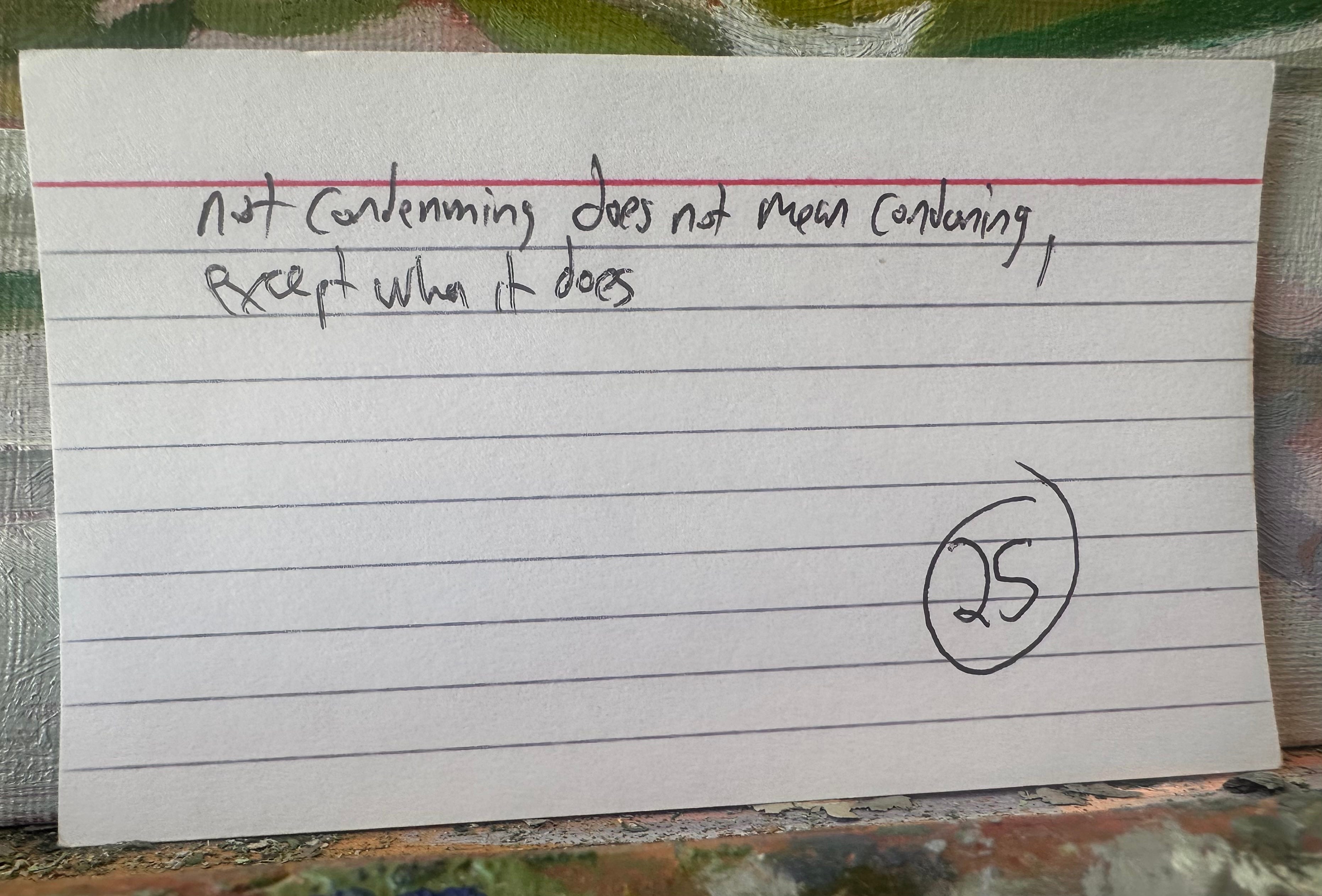
Not condemning does not mean condoning, except when it does.
Condemnation can be necessary, courageous, useful, effective, right, but it also can be easy, obvious, assumed, perfunctory, and misguided.
The public school on Long Island—not blue, not red, purple—where my wife teaches publicly condemned the assassination of Charlie Kirk and a school shooting that took place that same day, but said nothing about Renee Good or Alex Pretti, protestors murdered by federal agents in Minneapolis. A moment of silence on the anniversary of October 7, but nothing, ever, about Gaza.
Fascism has arrived, as it usually does, with a vengeance.
Marilynne Robinson, in “The Tyranny of Petty Coercion,” argues that when it comes to moral and intellectual courage—maybe everything—we are nudged, boosted, bullied, and shamed into consensus. If we take a position that we know will meet with approval—amazing, 💯, huzzah, amen—it isn’t courageous, even though it may be right. Thinking differently, risking ridicule and raised eyebrows, cold shoulders and ostracism, is, or at least can be, even if it’s wrong.
The march, the meeting, the petition, the donation, the yard sign, the likes, all culturally-sanctioned actions of resistance, but are they effective? Or is it performative outrage as a substitute for action? Bonhoeffer called this “cheap grace”—grace that demands no discipline, changes no behavior, but lets you keep thinking of yourself as a good person.
Of course, not all protests are created equal. Standing between an ICE agent and your neighbor is not the same as marching down Atlantic Avenue on a Saturday afternoon after your kid’s soccer game and before a sushi dinner. I'm not saying don't do the latter. I'm saying don't confuse the two.
The real activists—I know a few, thank you—have my respect.
People say, “Something is better than nothing. Showing up matters.” But is that necessarily so? A friend from Minneapolis who’s in it says: anger signifies and there’s joy in resistance. I get how anger works. I’m confused about joy. I’m not trying to make a case for doing nothing. At least I hope not.
I like the approach Leonard Bernstein suggested in a speech he gave two days after JFK’s assassination. His words are memorialized on a colorful mosaic on the outside wall of the boys’ music school: This will be our reply to violence: to make music more intensely, more beautifully, more devotedly than ever before.
“Am I doing enough?” Do I keep asking because I know I’m not, but asking maintains the illusion that I might be? Is it because I think I am, but can’t make the case? Is it doubt for the sake of doubt? Am I, like Louis CK, though metaphorically, masturbating in front of you without your consent?
(In case it doesn’t go without saying: I’m sorry if I offended anybody.)
My sister tells me that she and her friend have taken to considering that “we might be wrong,” but they always end up with “turns out we were right.” Shameless flirtation with fallibility runs in the family.
I’m taking a stand, or maybe it’s more of a stance. Is it courageous? I’m going to catch some flak for it, so that necessary condition is met. But there needs to be more to it. Is what I’m saying right? Is it doing any good? I’m confusing myself…perhaps not the most effective rhetorical approach.
I’ve been told, sometimes jokingly, sometimes not, that I have oppositional defiance disorder. It’s true that I do not have a good relationship with the word should.
Should is complicated. Silence is complicated. Resistance is complicated. Anger is complicated. Joy is complicated. Music is complicated. Saying something is complicated is complicated.
I do not understand who gets to call whom out—when and how, for what and why—and who doesn’t. “Why aren’t you going to the march?” you ask. You aren’t curious, it’s not an innocent question. You’re chastising me.
I, likewise, have a lot of questions, for you (fair is fair): about your parenting, your cooking, your carbon footprint, your search history, how you spend your money, the way you treat your wife.
You might be right: I should go to the march. But my questions, particulars on request, might, also—again, likewise—be right.
Still, I wonder if I defend my way of being simply and only because it’s my way of being.
I need a line, for the next time I’m asked why I didn’t go to the march. I can’t think of one. That’s a problem. I don’t want to come across as an asshole. Maybe that’s a problem too.
Of course, not complicated, we all know: if you don’t want to be an asshole, don’t be an asshole.
Beautiful piece, thank you. I am touched, in particular, that you went to the house of Primo Levi and saw the staircase.
I love reading your stuff. Thanks for putting it out there. Love to all.